Welcome to the blog post for Episode 8 of Spearpoint, which you can listen to via the audio feed above. If you use Apple Podcasts or Spotify, we are also available there, as well as on your RSS Feed.
As always, we hope you find this blog post a useful companion to the podcast. If you have any comments or queries, please feel free to leave a comment or send us an email: spearpointatg@gmail.com!
Advertisement: Silly and Serious Malcolm remains unmarried and despite being a romantic is happy to marry for money as long as his suitor has LOTS of it! Enough, we think, to buy all the books about Alexander in the world.
On the other hand, if you are a publisher or literary agent who would like to learn more about Francis’ Roxane book, email us spearpointatg@gmail.com and Francis will get in touch with you.
A Quotable Song At the start of the episode, Malcolm refers to Sufjan Stevens’ song Mystery of Love, which contains the line,
Like Hephaestion, who died Alexander’s lover
If you would like to hear the song, you can do so here:
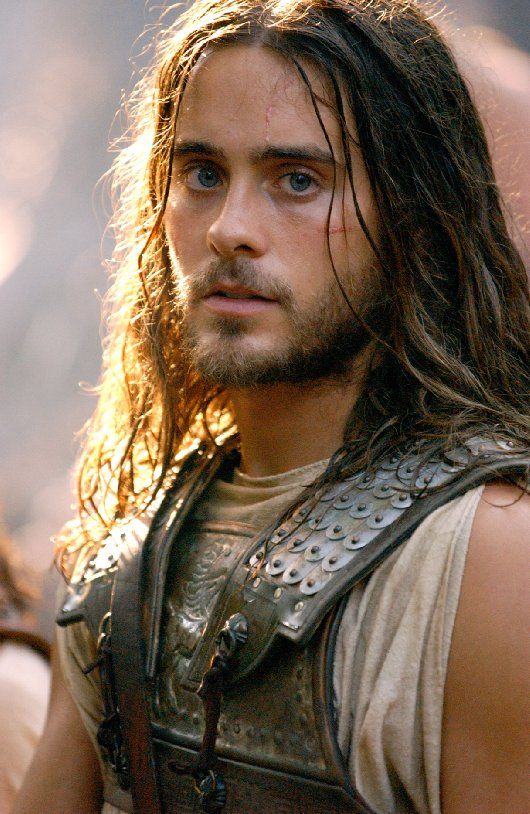
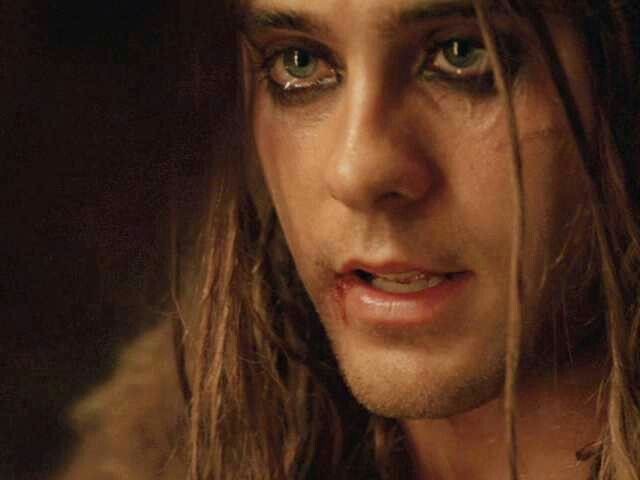
Jared Leto Malcolm prefers Jared Leto without his beard. Here he is in Oliver Stone’s Alexander without and with. Which do you prefer?
credit elsasfigueiredo | pinterest
credit: acfr1968 | pinterest
In the film, Leto’s appearance(as well as that of other Macedonians) changes to reflect the influence of Alexander’s expedition on him. For that reason, we not only see Leto’s Hephaestion with a beard, but also black eye liner, which reflects his pro-Persian sympathies.
credit: Rubyraven1408 | pinterest
Men in Grey Suits (or Armour) If you would like to read about how Parmenion and Antipater tried to pursued Alexander to father a child (that is, an heir) before beginning his Persian campaign you can do so by turning to Diodorus XVII.16.
He too is Alexander
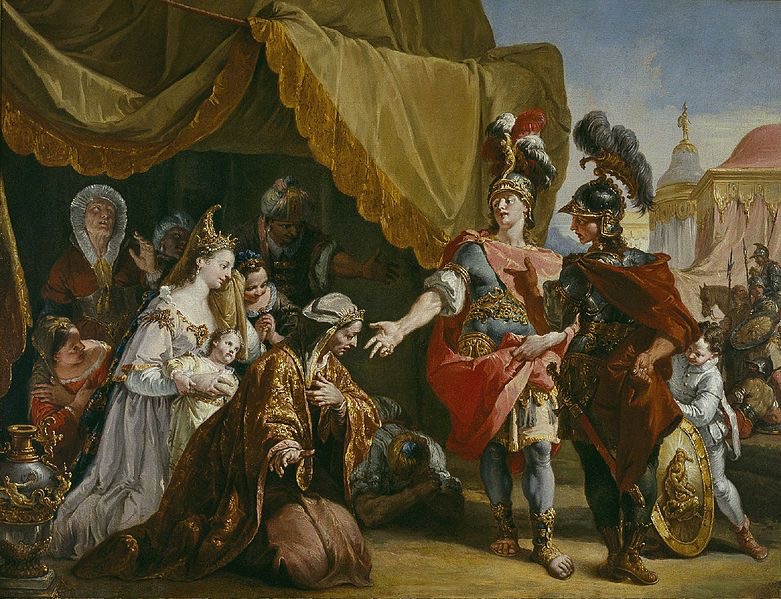
credit: wikimedia | pinterest
And if you would like to read about Alexander’s famous meeting with the Persian Royal Family in 333 BC following the Battle of Issus here is where you can do so.
(No Justin or Plutarch as they do not mention the story)
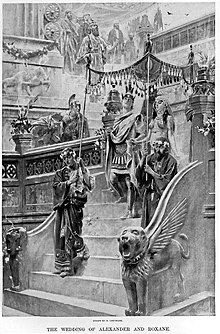
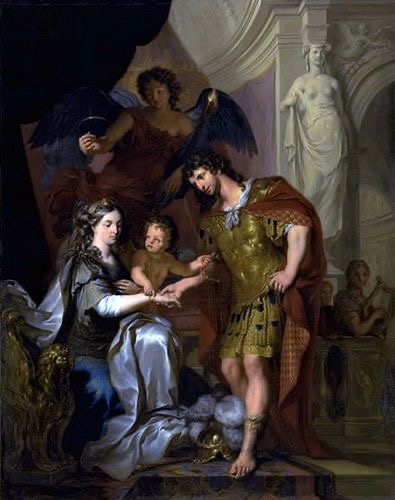
Alexander and Roxane’s wedding Here are a couple of artist’s interpretations of Alexander and Roxane’s wedding. First up is this illustration by Andre Castaigne (1861-1921):
credit: 6kera10in | pinterest
And this painting is by Arnold Houbraken (1660-1719).
credit: pinterest
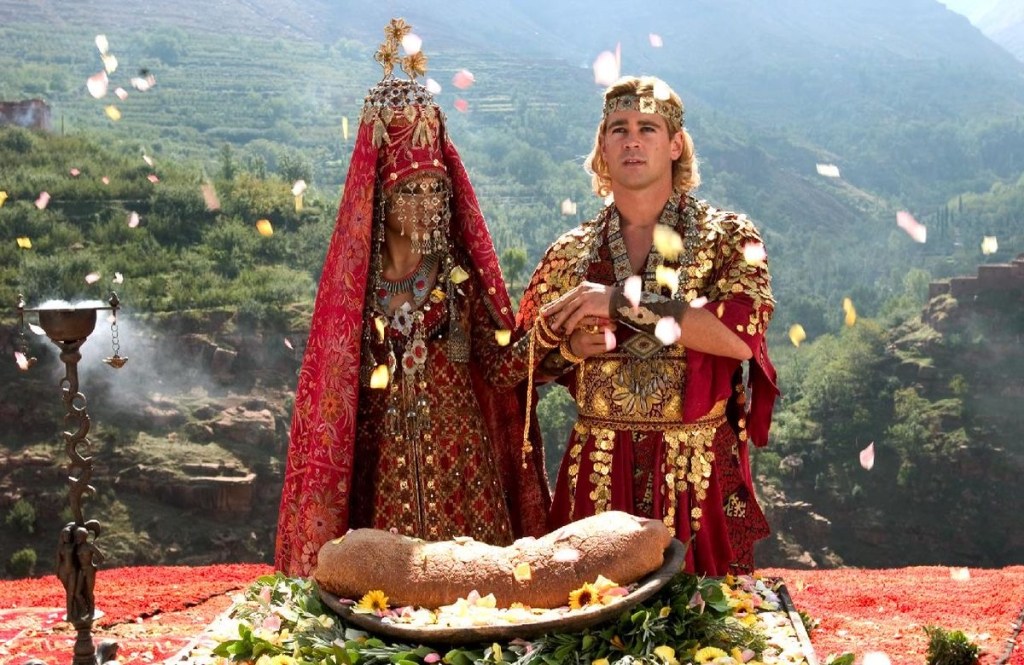
Finally, here is how Oliver Stone portrayed Alexander and Roxane’s wedding at the moment they cut the loaf of bread in the traditional Macedonian fashion.
credit: acfr1968 | pinterest
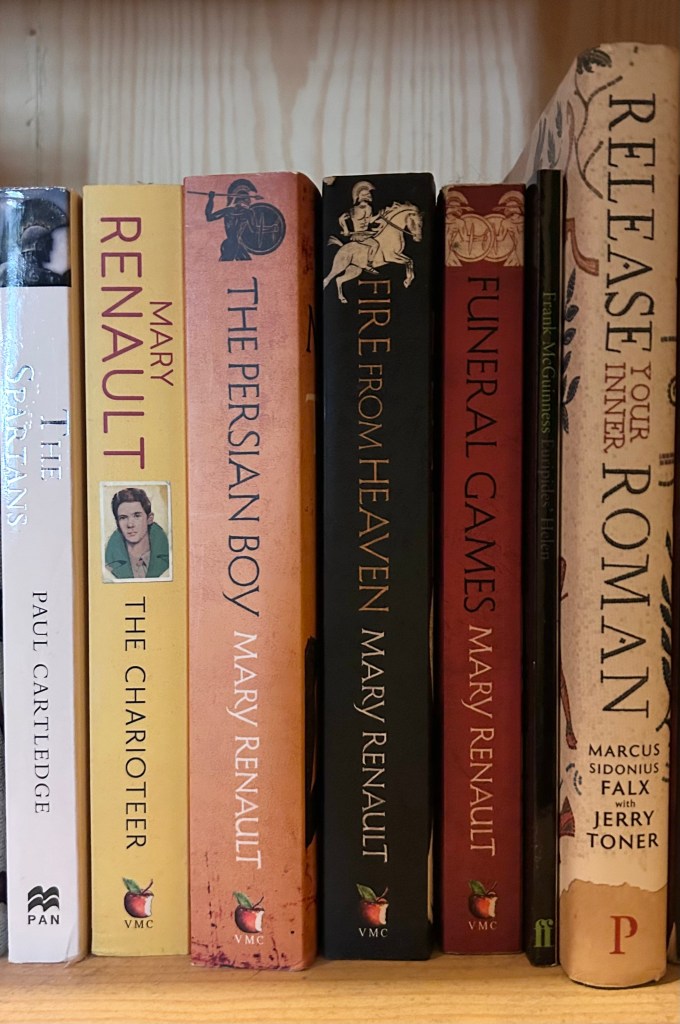
Mary Renault Mary Renault wrote a trilogy of books about Alexander. Here they are on Malcolm’s bookshelf!
credit: m.j.mann
(Don’t be distracted by The Charioteer that is its own novel)
The Kiss is (Not) Just a Kiss Apart from the kiss that Alexander gives to Bagoas after the latter wins the dancing competition (Plutarch Life of Alexander67) kissing is not mentioned in the ancient sources. While this is true in regards the romantic kiss, other types of kissing do occur. For example, during his famous meeting with the Persian Royal Family after Issus, Alexander kisses Stateira I’s son Ochus (Diodorus XVII.38). There is also the kiss of respect that comes with proskynesis. Finally, Plutarch tells us that Alexander allowed Hephaestion to read his private correspondence. To make sure the latter did not reveal its contents (not that he would have done), Alexander held his ring of office to Hephaestion’s lips and had him kiss it. This scene has been portrayed in numerous artworks, including the painting below by Johann Heinrich Tischbein:
Euxenippus A thank you to Pothos for the detail about Euxenippus. This great website has a whole section dedicated to Alexander’s lovers, which you can read here.
Ochos or Arses? Which Great King did Artabazos rebel against? Malcolm wasn’t sure if it was Artaxerxes III Ochos or Artaxerxes IV Arses. Well, he was right the first time! Artabazos rebelled in 352 BC against Artaxerxes III Ochos.
Welcome to Spearpoint’s Episode 7 art gallery! Ideally, you’ll read this blog post and view its images while you listen, or after you have listened, to Episode 7 (above). For that reason, the images are given in the order in which Malcolm and Frances discuss them. However, we wouldn’t want the blog post to make no sense at all just because you haven’t yet heard the podcast, so, brief explanations of each image have been provided. We hope you find them useful! If you have any comments, we’d love to hear from you either in the comments box or by email – spearpointatg@gmail.com.
Before beginning, we should add that if you would like to see our blog post for Episode 6, just click here, and if you would like to see more images of Alexander, Episodes 6 and 7 have their own Pinterest boards @spearpointatg!
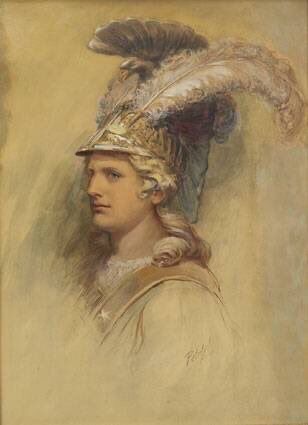
One Episode 7 starts with this 1915 illustration of Alexander by August Petrtyl (1867-1937). Malcolm noted Alexander’s uncertain gaze: could it have been influenced by the First World War, which was then convulsing Europe? In a discussion of the Macedonian king’s hair, Malcolm reveals his rather unusual fashion taste!
credit: @twitter on pinterest
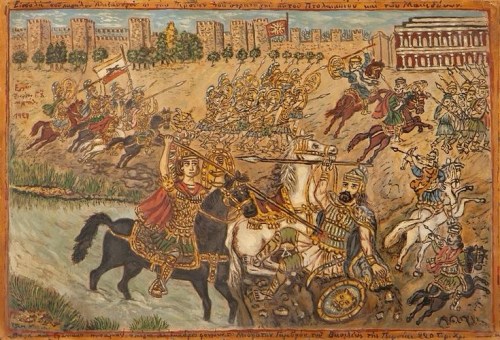
Two Theophilos Hatzimihail (1870-1934) was a folk artist whose work more than makes up in drama what it lacks in sophistication. Hatzimihail created this piece, which is a portrayal of the Battle of the Granicus River, in 1927. Full of action and drama it is a very raw but well thought out illustration.
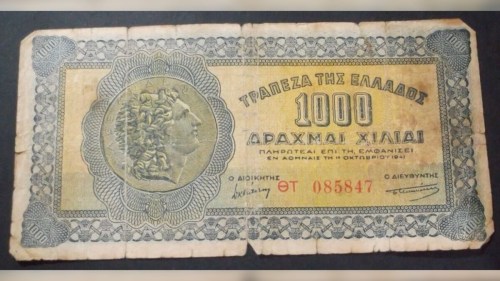
Three This Greek 1,000 drachma bank note went into circulation in 1941. Just as in the idealistic portrayals from antiquity, Alexander gazes into the distance, here with his head slightly tilted upwards. As Malcolm and Frances note, this image of Alexander is not the divine Alexander: he lacks his ram’s horns and larger-than-normal eyes – perhaps a nod, as Malcolm says, to Christianised Greece.
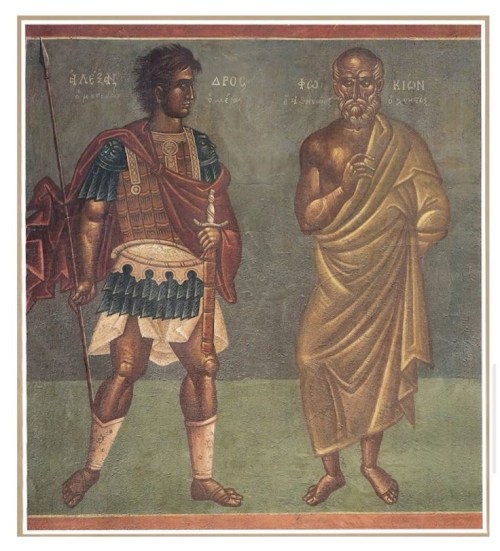
Four This art work is by Photis Kontoglou (1895-1965). While the art style is Byzantine, Alexander’s head surely owes its origin to the Alexander Mosaic. The man on the right is a Greek statesman named Phocion. The art work can be found in Athens’ City Hall and is part of a much larger work that wraps around all four walls of the Municipal Council Chair’s office.
credit: National and Kapodistrian University of Athens
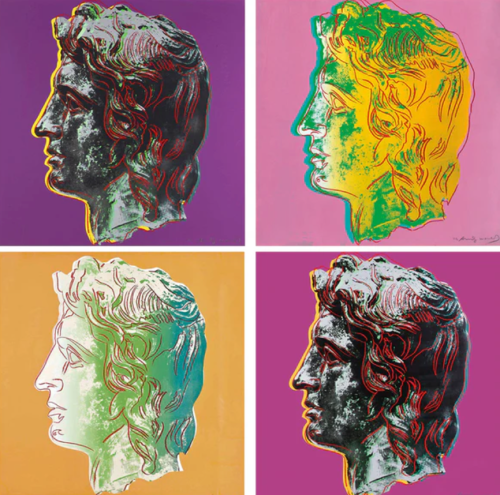
Five Having spent some time with images from Greece and by Greeks, we now move to the United States of America and the man who invented pop art: Andy Warhol. This image was commissioned by his friend Alexander Iolas and was created in 1982. Given Alexander’s fiery nature, the red background and streaks in his hair bring out his character perfectly.
Here is the image that Warhol used to create his print:
credit: (unknown. if you know to whom this photograph belongs please let us know)
Note the crack in Alexander’s left eye. While it does look rather like a lightning bolt, it isn’t quite in the right place to make Alexander look like Harry Potter!
Here are some more versions of Warhol’s Alexander. These come (and can be bought) from the Tallenge Store here
credit: Tallenge Store
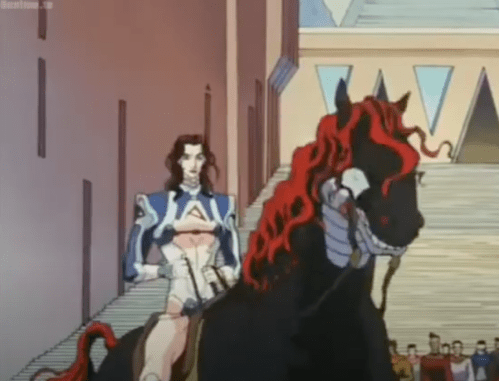
Six With the screenshot below we come to the world of moving images. Alexander Senki (1999) is a Japanese anime series loosely based on Alexander’s life. Loosely being the operative word here. The series combines history with science fiction. Darius III, for example, does not drive a chariot but a very futuristic tank.
In this screenshot, we see Alexander astride a red maned Bucephalus. You would be forgiven for not recognising Alexander but if you have read stories of the man eating Bucephalus, he perhaps will not look so strange to you.
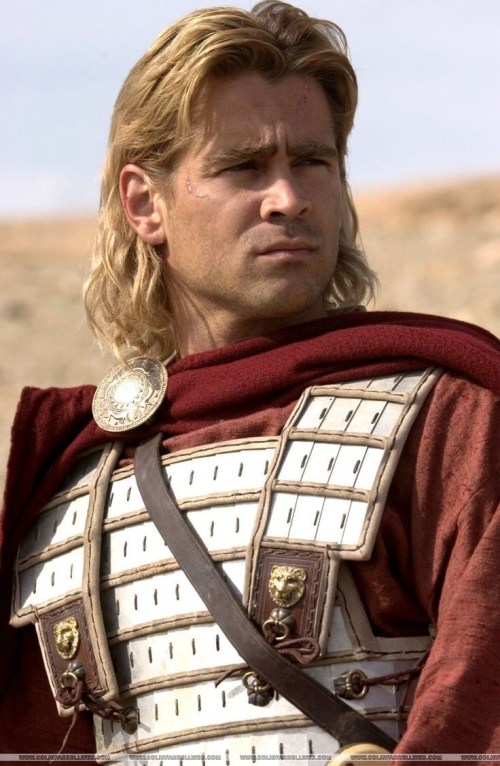
Seven In 2004, famed director Oliver Stone released Alexander. It was an epic film with production values of the highest order but still not a success. An implicit acknowledgement of this has been Stone’s release of not one but several different versions of the film in the years since then: all attempts to find the best picture.
Did you know that Alexander scholar Robin Lane Fox is in the film? He plays a Macedonian cavalryman at the Battle of Gaugamela! See if you can find him: The Battle of Gaugamela Part 1, Part 2, Part 3, Part 4
Read Lane Fox on his experience working for Stone here
credit: @acfr1968/pinterest
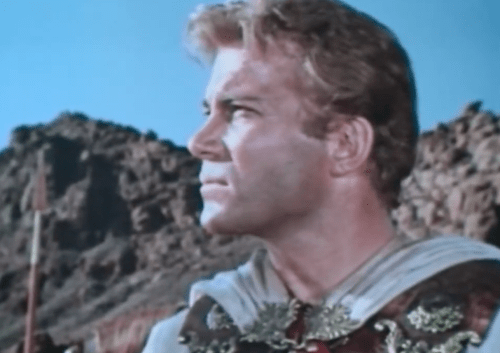
Here is William Shatner as Alexander from the 1963 pilot Alexander the Great. Unfortunately, the programme was never picked up as a regular series. Antiquity’s lose was science fiction’s gained as Shatner would go on to star as Captain James T. Kirk in Star Trek.
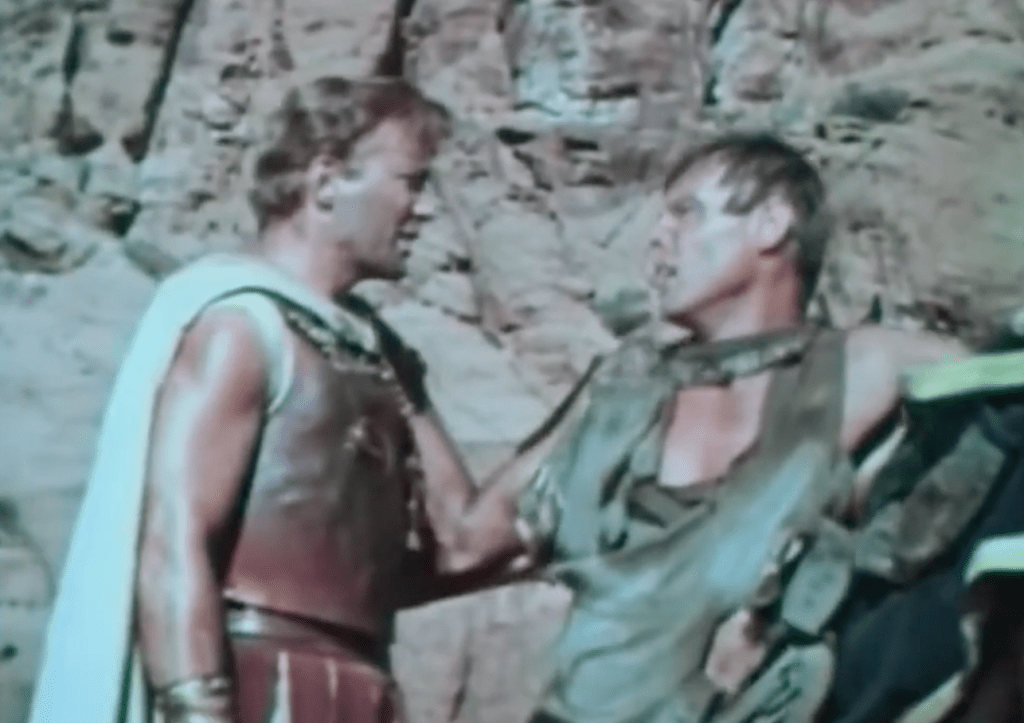
William Shatner wasn’t the only future hero who appeared in the pilot. Starring alongside him was none other than Adam West as a Macedonian named Cleander. Three years after Alexander the Great, he would become Bruce Wayne and Batman.
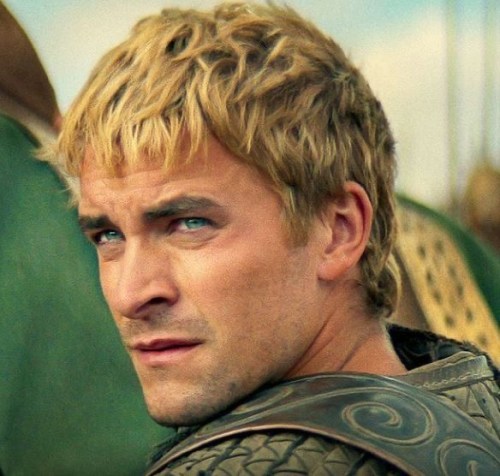
Eight Twenty years after Oliver Stone’s Alexander hit the big screen, the conqueror returned to the small with the release of Netflix’s docu-drama Alexander: The Making of a God. The Macedonian king was played by Buck Braithwaite (below). Like Farrell, his hair is blonde (also like Farrell, Braithwaite is naturally dark haired). His Alexander, however, is a more restrained and menacing figure in comparison to Farrell’s melodramatic one.
credit: @showbizhut/pinterest
An oak tree. Why is this here? For the answer to that, we’ll let you listen to the podcast! A clue: the oak is, of course, Alexander (1:01:21 onwards!)
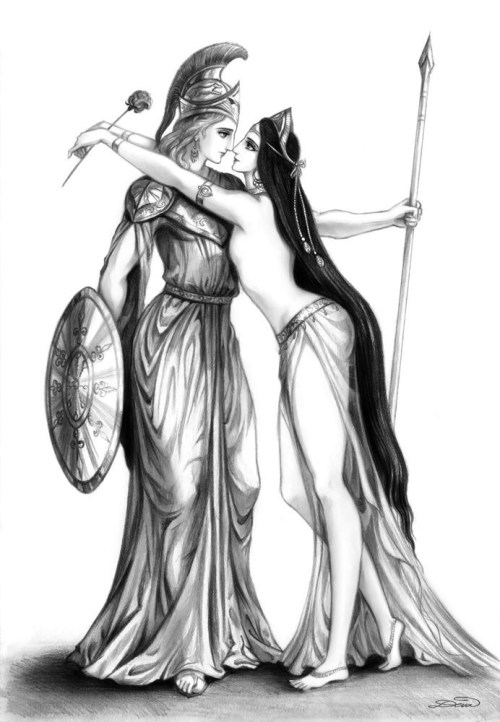
Nine The late twentieth and first quarter of the twenty-first century have seen great progress in the fight for LGBTQ+ rights throughout the western world. That fight is still a long way from over but queer people are now far more accepted than ever they were before. The arts has played its part in this change. For example, both Alexander (2004) and Alexander: The Making of a God (2024) show Alexander and Hephaestion as lovers. That trend continues in this artwork by Develv, which shows a very feminised Alexander (L) and Bagoas (R) in a loving embrace. With their long hair, flowing robes and curved bodies, both Alexander and Bagoas could easily be taken for women. Have they been emasculated? Well, in respect of Alexander, surely it does something else entirely; namely, alert us to an aspect to his character, rarely, if ever*, explored before: his feminine side.
*It is certainly a world away, for example, from William Shatner’s Alexander
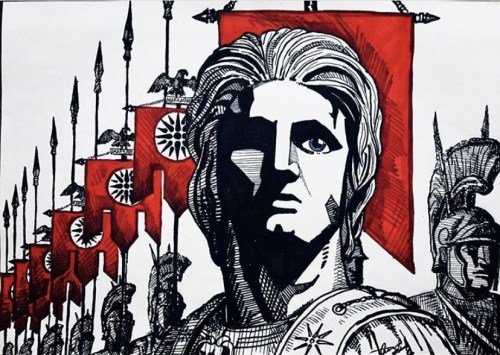
Ten This illustration of Alexander by @stathopoulos_theodoros_ii (Instagram) is a deeply unsettling image in that it uses an artistic style redolent of Nazi art to portray the conqueror. What is the artist saying here, and about who?
credit: ggdmiz/pinterest
+++
When we recorded Episode 7 our conversation went on for an hour and a half. To bring the episode down to a slightly more manageable length, we had, unfortunately, to cut out our discussion of several pieces of art. Here are a couple of them.
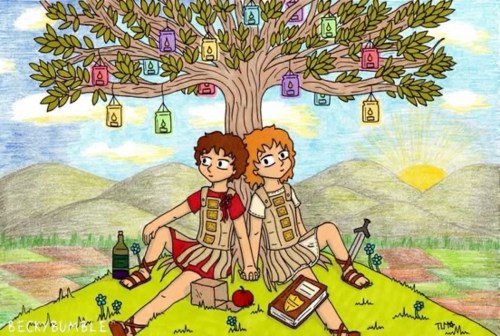
This illustration by BuckyBumble is a particular favourite of Malcolm’s as it combines Alexander with one of his most favourite books, Brideshead Revisited. Early on in their friendship, during the halcyon days of their youth at Oxford, Sebastian Flyte takes Charles Ryder for a drive. It is a beautiful day, and they stop by the roadside for a picnic. This is, Sebastian says, “Just the place to bury a crock of gold… I should like to bury something precious in every place where I’ve been happy and then, when I was old and ugly and miserable, I could come back and dig it up and remember.”
credit: BeckyBumble (@beckybumble_art on instagram)
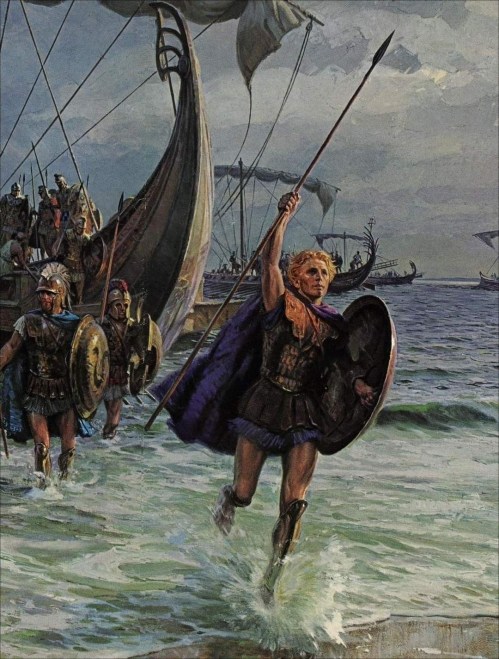
Finally, here is Tom Lovell’s portrayal of Alexander running ashore in Asia Minor. In a few seconds time, he will throw his spear into the sand and claim the Persian Empire as his spear-won territory. It is a very heroic moment, intriguingly undermined, however, by Alexander’s pinched appearance, which gives his face a skull like look.
credit: denneym642/pinterest
Thank you for reading! We hope you enjoyed viewing the images and the listening to the podcast. Do you have any favourites of Alexander? We’d loved to hear which ones! Let us know in the comments below.
Welcome to Spearpoint’s Episode 6 art gallery! Ideally, you’ll read this blog post and view its images while you listen, or after you have listened, to Episode 6. To that end, the images are given in the order in which Malcolm and Frances discuss them. However, we wouldn’t want the blog post to make no sense at all if you haven’t heard the podcast, so, brief explanations of each image have been provided. We hope you find them useful! If you have anything you would like to add, please feel free to do so in the comments.
Before beginning, we should let you know the following: (1). Episode 6 covers images created between Alexander’s own lifetime and the end of the nineteenth century. In Episode 7 we will be looking at images created in the twentieth and twenty-first century (2). When it comes to ancient busts/statues of Alexander, we only know for sure that they depict Alexander himself when he is named on them. Of the three busts of him included below, only the Azara Herm includes Alexander’s name. The others are believed to be him on the basis of their appearance. You can learn more about Alexander’s iconography in the description of the British Museum bust at No.2 (3). Finally, if you would like to see more images of Alexander, you can do so on our Pinterest page @spearpointATG. We have a number of boards, including two dedicated to Episode 6 and 7. As for the blog, do check back as we will have another blog post art gallery dedicated to the images discussed in Episode 7
With that said, let’s take a look at these images of Alexander!
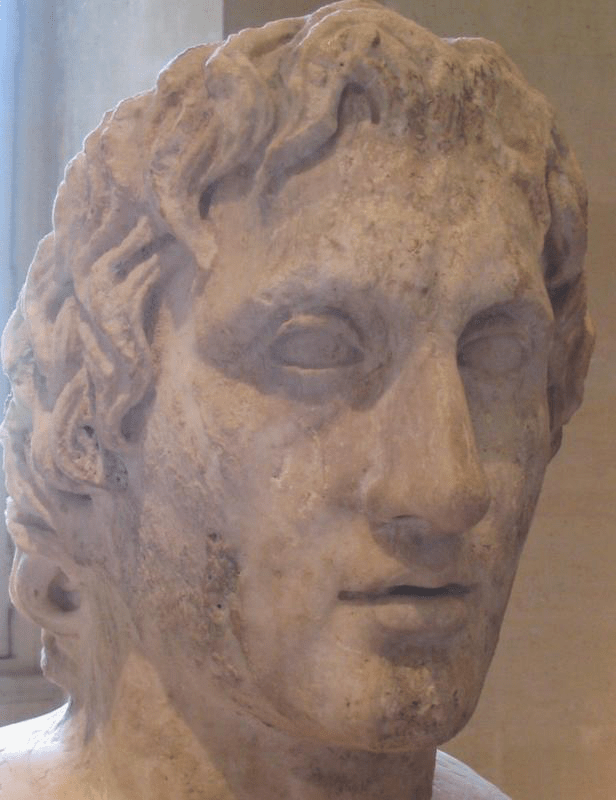
One First up is the Azara Herm, which is held by the Louvre in Paris. The Herm is believed to be a Roman copy of a bust by Lysippus, one of the few artists that Alexander allowed to portray him. For this reason, it is thought to represent what the Macedonian king really looked like. While the Azara Herm is undoubtedly the most famous example of a realistic portrayal of Alexander, it also contains elements of what you might call Alexander’s ‘idealistic iconography’ – the wavy, leonine hair, smooth skin and parted lips. Where it differs is in the determined eyes looking straight forward, focusing on the here-and-now rather than future.
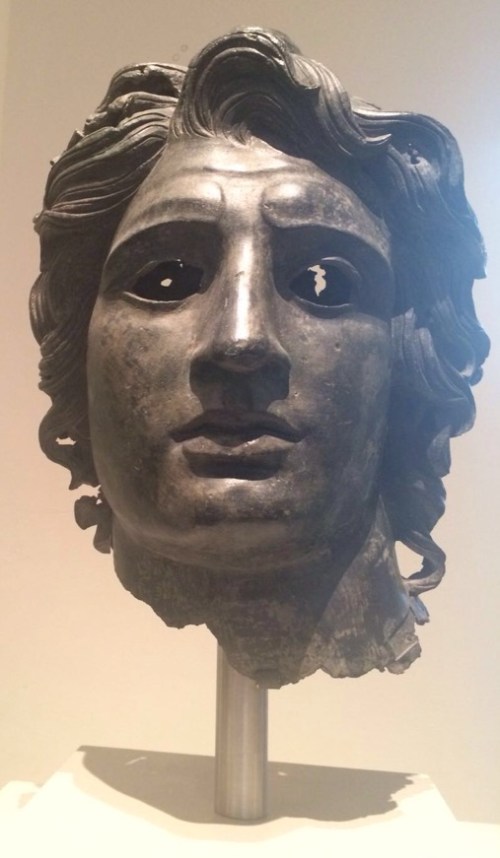
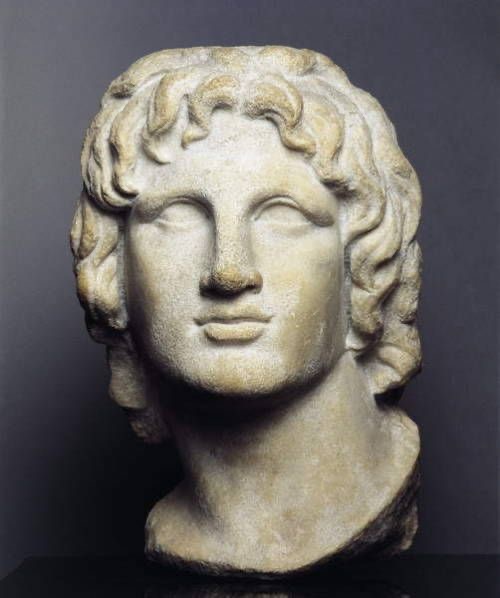
Two The British Museum bust of Alexander (dated to the 2nd-3rd Century BC) is one of the most famous idealistic images of the conqueror. We call it an idealistic image on account of the following: – The leonine hair which recalls Alexander’s ancestor, Herakles – The smooth/clean shaven skin. In ancient Macedonia and Greece men almost always had beards. Alexander’s decision to shave was a radical departure from this norm – The dreamy eyes looking to the future, dreaming of future conquest and glory (see also 10 below) – Theslightly parted full lips about to give an order? Or maybe speak softly to someone, maybe even kiss. Alexander is a warrior but the lips tell us he is much more than just that – The tilted neck. This gives a sense of motion, of Alexander having an interest in what he is seeing before him – The Anastole. Anastole is a Greek word meaning ‘extreme cow lick’. You see it in busts when the front of the centre parting is lifted up, as if a cow had just licked the person’s face. It doesn’t feature on the British Museum bust but can be found on other idealistic images of Alexander (see also 7 below)
The bust was found in Alexandria so surely comes from the home of an extremely well-off person. It may even come from the royal palace of the Ptolemies. By the by, this bust probably reflects the popular (as opposed to academic) view of Alexander today: an out-and-out hero
credit: egyptomuseum/pinterest
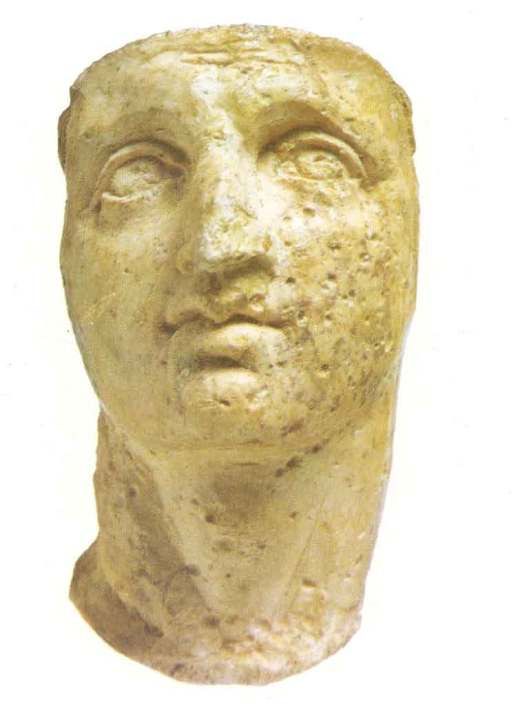
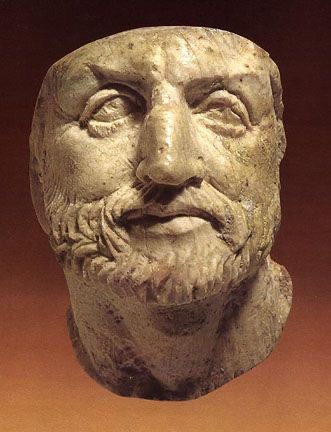
Three When Manolis Andronikos discovered the Vergina Tombs in 1977, he interpreted the ivory heads that you see below as being Alexander and Philip II. This is because they resembled other images of the conqueror and his father. For example, Alexander has a slightly tilted neck, clean shaven skin, and dreamy eyes. However, if it is Alexander, that would mean that by no later than 338 BC, Alexander’s idealistic iconography had already taking root. Is this realistic?
credit: balsa7/pinterest
As discussed by both Frances and Malcolm, Philip also has a neck tilt. Could this be evidence that Alexander’s was hereditary?
credit: behindthename/pinterest
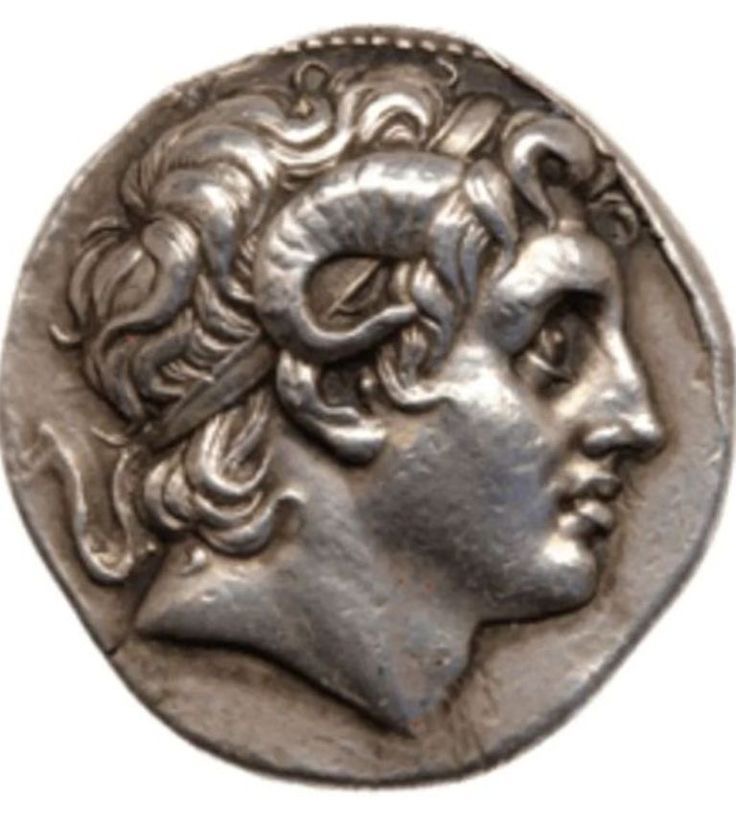
FOUR As Frances says, this coin, a tetradrachm, was minted either by Alexander towards the end of his life or by one of his generals and Successors. As you can see, Alexander appears with his trademark leonine hair and wears the royal diadem. The most obvious and outstanding feature of the coin, however, is, of course, the ram’s horn. Alexander claimed to be the son of Zeus-Ammon who, in his Egyptian guise as the god Ammon (aka Amon, Amun), had a ram’s head. It’s appearance on a coin indicates that either Alexander or one of his Successors wanted him to be seen as a god.
The issue of Alexander’s divinity is a much debated one. If you would like to know more, check out Spearpoint Episode 4 where Malcolm and Frances discuss this very subject. Go to Apple Podcasts or Spotify, or listen to it on this blog!
credit: TisTheAlex/pinterest
FIVE The Porus Medallion, below, is one of the most famous objects from Alexander’s own lifetime. On the obverse side we see a cavalryman attack two Indian soldiers on an elephant. On the reverse a single figure holds a long object while another person hovers over them. To take the obverse side first, it is believed that the cavalryman is Alexander, attacking Porus and the Indian king’s mahout as they flee from him. On the reverse side, the object being held by the figure is a lightning bolt. In ancient art, only Zeus ever holds a lightning bolt. The figure below, therefore, can only be the man who claimed to be King of the Gods’ son: Alexander. The figure hovering over him is Nike: the ancient Greek personification of Victory. We’ll meet her again in No. 11.
SIX As mentioned by Malcolm, Oliver Stone used the Porus Medallion in his film Alexander (2004). Here is a still of that very scene. As you can see, Stone has adapted the image of the medallion rather than simply copied it: the Indian elephant faces Alexander, as do both Indian warriors atop it.
If you would like to watch the the whole battle, you can find it on YouTube. Part One is here, and Part Two here. But Beware: It is not for the faint hearted!
credit: Twitter (X) page now deleted
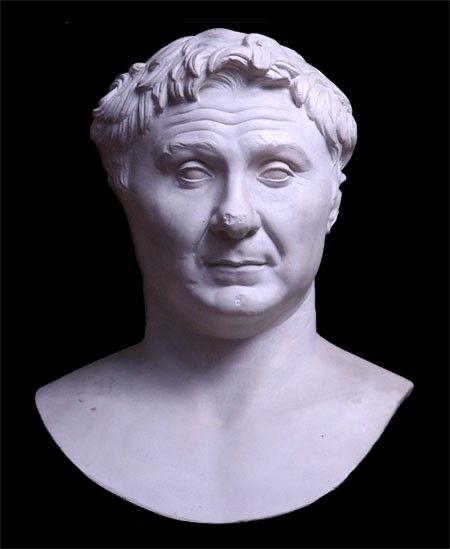
SEVEN Below is a photo of Pompey Magnus with his Alexander inspired hair. At first glance it doesn’t look like he has made much of an effort at all to copy his hero. For whereas Alexander’s hair is long and wavy, Pompey’s is short and flat. But look at the upturned centre – that is Pompey’s very own anastole, his extreme cow lick!
credit: okiegator65/pinterest
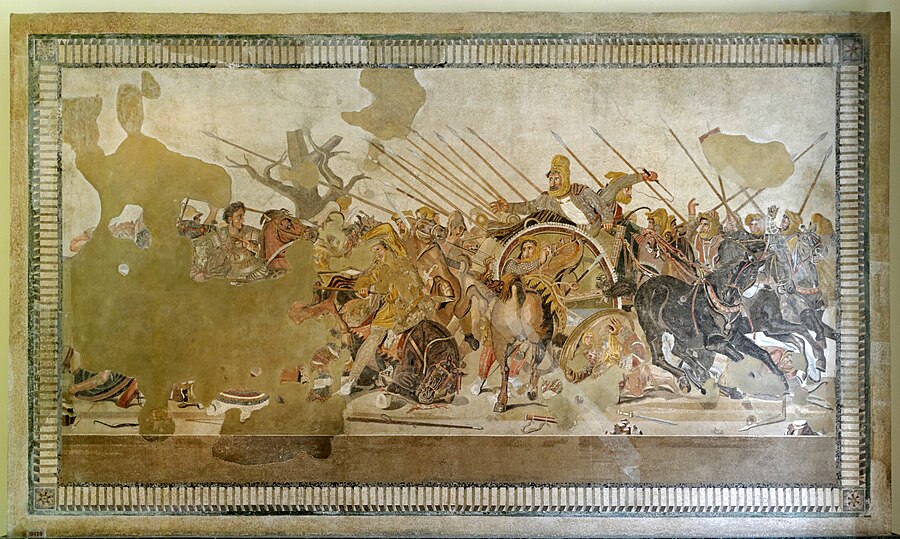
EIGHT Along with the British Museum bust of Alexander, the Alexander Mosaic is one of the most famous ancient images of Alexander that is still extant. The mosaic, which was found in The House of the Faun in Pompeii, is dated to the 1st-2nd century BC and is believed to be a copy of an ancient Greek painting. Note Alexander’s large eyes, which indicate his divinity, leonine hair and – perhaps a very Roman touch – his long sideburns
credit: maryluzpegaso/pinterest
For reference, the full mosaic is as below. Given the amount of damage to it on the left hand side, we are very lucky to still be able to see the figure of Alexander as he prepares to attack the Great King, Darius III, who stands in his chariot with arm outstretched just right of centre.
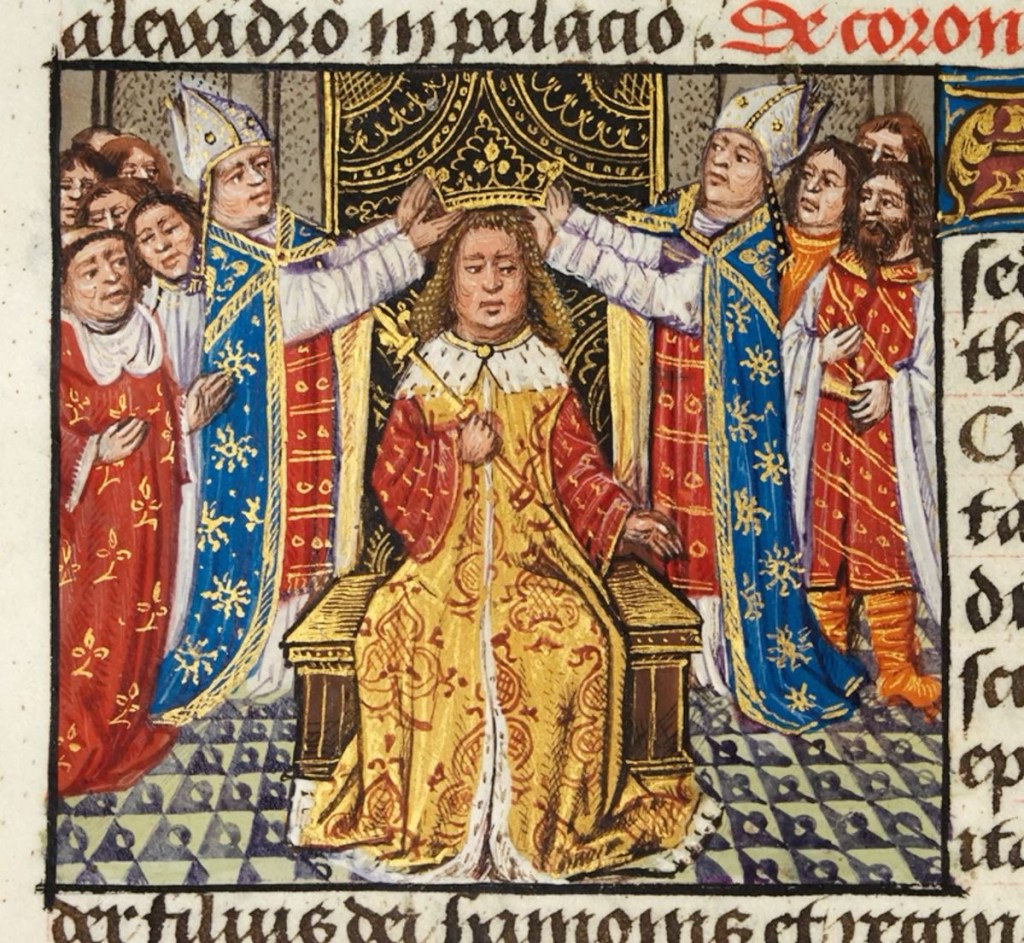
NINE This coronation of Alexander was created for a fifteenth century version of The Alexander Romance. The inclusion of the bishops and monk, and use of medieval clothing, point to the artist wanting to make the scene as relatable as possible to his audience. By having bishops crown Alexander, they are also, in a sense, christianising him. Alexander, of course, lived three hundred years before the birth of Christ. Despite this, he plays an important part in the spread of Christianity, through the establishment of the Greek language and Greek ideas across the Middle and Far East. Without Alexander, St. Paul et al would have found it much harder to make themselves understood outside Judaea.
TEN The next two images also come from medieval copies of The Alexander Romance. In the first we see Alexander being lowered into the depths of the sea in a barrel; in the second, six griffins fly him into the sky. The two images share one theme: Alexander as an explorer. As it happens, the real Alexander never explored any unknown lands. Despite this, the idea of him being an explorer as well as conqueror took root in the Romance and in its pages he visits a variety of incredible places, including the end of the world and paradise. Arguably, the idea of Alexander the explorer didn’t start with the Romance but with his idealistic portrayal. Go back to the British Museum bust, above, and look for a moment at his eyes. They are not the eyes of a man who is focused on the here and now; but rather, are looking to new lands, new worlds, somewhere, out there… beyond the horizon.
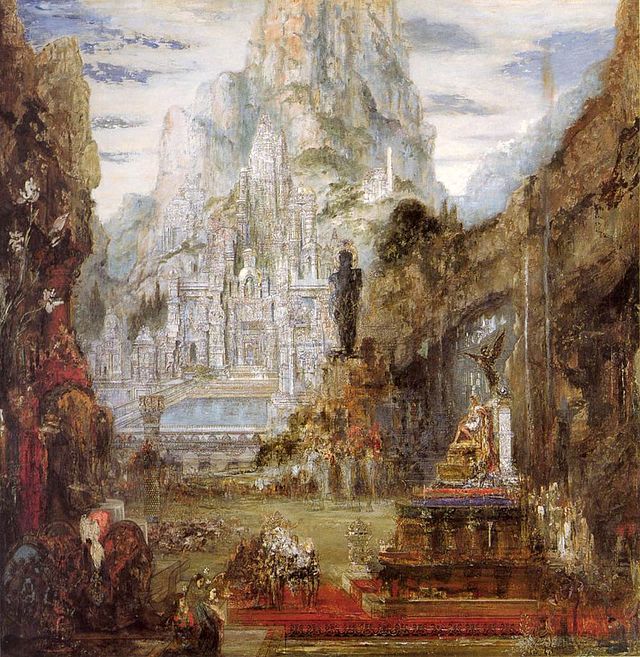
ELEVEN As he says in the podcast, The Triumph of Alexander by Gustave Moreau (1826-1898) is one of Malcolm’s favourite portrayal of the Macedonian king. Epic in scope, it captures Alexander at the height of his power but also points to the loneliness of his position as conqueror. As with the Porus Medallion, Nike hovers overhead, but what price victory? Isolation? Was it worth it, then? The Triumph is a profoundly exciting and sad work of art.
TWELVE We come to the end of our all too brief tour of images of Alexander with a favourite of Frances’s. Augustus at the Tomb of Alexander by Jean-Eugène Buland (1852-1926) is based on Suetonius’ account of Augustus Caesar’s visit to Alexander’s tomb in Alexandria following his defeat of Mark Antony and Cleopatra in 30 BC. Suetonius tells us in his Lives of the Caesars that Augustus placed a golden crown and flowers on Alexander’s sarcophagus. The new Roman emperor was asked if he would like to see the tombs of the Ptolemies as well, to which he replied, I came to see a king, not dead bodies. Buland has removed the sarcophagus so that we can draw almost as close to Alexander as Augustus. The new Roman leader, however, is portrayed with all the arrogance of his response above
So, there you are; we hope you enjoyed this whistle stop tour of images of Alexander through the centuries. As mentioned above, Episode 7 of the podcast will be bring the journey up-to-date with a look at images from the twentieth and twenty-first century. See you then!
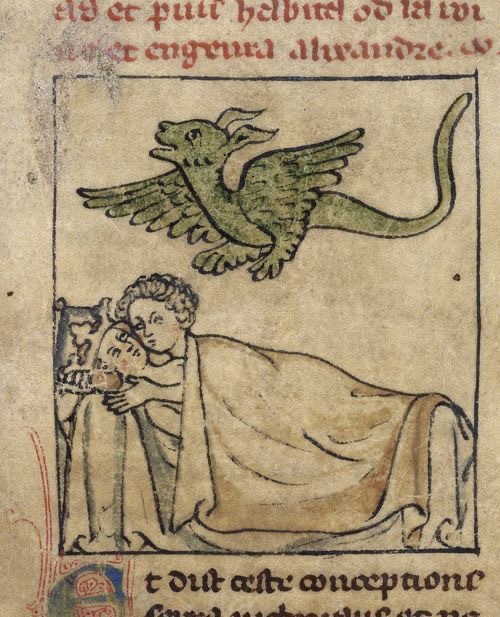
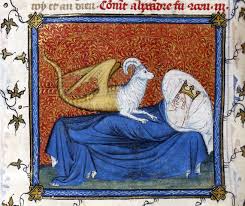
In Episode 5 of the podcast, we talked about Alexander the Great’s ‘divine’ conception. Malcolm mentioned artistic portrayals of his conception and here they are!
As the story goes, Olympias slept with the Graeco-Egyptian god Zeus-Ammon who appeared to her in the form of a snake or dragon.
In the first image below, we see Olympias and Zeus-Ammon in bed together. On the left is Philip peering through a hole in the door. The image has its source in Plutarch’s Life of Alexander Chapters 2-3 where Philip’s love for his wife is described as having cooled after he saw her in bed with a snake (Zeus-Ammon). The Delphic Oracle then informs Philip that because he looked through the door, he will lose the eye with which he saw the god and his wife.
In the image below Olympias is represented as being in bed with another human being. That person’s true identity, however, is indicated by the dragon flying above them.
However, the human could also be the last native Egyptian king, Nectanebo II (360-343 BCE) who, according to the Alexander Romance seduced Olympias while pretending to be Zeus-Ammon.
source: profknj / pinterest
Below, Olympias lies in bed with Zeus-Ammon on top of her sheets. Unlike in the other images, the god here is half dragon-half goat. In ancient Egyptian religion, Ammon is portrayed with goat horns. Alexander would go on to be portrayed in this way as well.
Alexander the Great is a figure of such historic importance it can be easy to forget where he came from. His father, Philip II, makes himself known by his own achievements. But what about his mother, Olympias?
Dynamic, ruthless, and determined; by force of personality, and the fact that the crown prince of ancient Macedonia was her son, Olympias did her utmost to bend the world to her will.
In this episode of Spearpoint, Malcolm and Frances explore Olympias’ origins, her relationship with Alexander after the beginning of his war against the Persian Empire, and what part she played in Alexander’s understanding of his divinity. They also look at whether Olympias conspired to assassinate Philip II and what happened to her after Alexander’s death in 323 BCE. From court politics to clashing personalities; power struggles and assassinations, Olympias’ life has it all.
About Malcolm and Frances Malcolm spends his days with his head in books and his heart in faraway lands, especially ones conquered by Alexander. When he looks at maps of Alexander’s empire, his go-to response remains “Crikey”. Frances is an academic who specialises in Hellenistic numismatics. She is currently writing a novel about Alexander’s first wife, Roxane, bringing life to the woman who existed in the shadow of a man who was larger than life.
In the winter of 331 BCE, Alexander the Great visited the famed Oracle at Siwa in the Egyptian desert. There, it is said, he discovered an amazing truth: he was not the son of Philip II but of the god Zeus-Ammon.
This news did not come out of the blue. Alexander had grown up close to the gods. Through his ancestors Herakles and Achilles, they were even part of his family.
In The Man Who Became a God, Malcolm and Frances explore these links, what Alexander made of the Oracle’s news, and Alexander’s connection to Dionysus. Their conversation takes them from a snake in the Macedonian palace to a drunken revel in India, from war against Tyre to a scandal in Bactria. Stepping beyond the literary sources, they also dive into what Alexander’s coins say about his supposed divinity and how it was used by his successors after Alexander’s death.
About Malcolm and Frances Malcolm spends his days with his head in books and his heart in faraway lands, especially ones conquered by Alexander. When he looks at maps of Alexander’s empire, his go-to response remains “Crikey”. Frances is an academic who specialises in Hellenistic numismatics. She is currently writing a novel about Alexander’s first wife, Roxane, bringing life to the woman who existed in the shadow of a man who was larger than life.
Alexander the Great not only conquered the Achaemenid Persian Empire, but also many nations in Central Asia and parts of ancient northwest India. In ten years of campaigning, he did not lose a single battle. He became the richest man in the world, and was regarded by many as a god.
Despite this, none of his men, indeed, no ancient Macedonian, ever called him ‘the Great.’ So, where did this title come from? What was Greatness when it came to a king? What role might a monk in his cell during the age of Charlemagne might have played in its story? And is it appropriate for us today to still call Alexander, ‘the Great?’
All of these questions, and more, are answered as Malcolm and Frances explore the origin and history of Alexander’s enduring epithet.
About Malcolm and Frances Malcolm spends his days with his head in books and his heart in faraway lands, especially ones conquered by Alexander. When he looks at maps of Alexander’s empire, his go-to response remains “Crikey”. Frances is an academic who specialises in Hellenistic numismatics. She is currently writing a novel about Alexander’s first wife, Roxane, bringing life to the woman who existed in the shadow of a man who was larger than life.
Alexander the Great (356-323 BCE) is one of the most influential men ever to live. Through his conquests, he changed the world forever, politically, socially, and even physically.
Today, our knowledge of what Alexander achieved comes from five writers, known collectively as the Alexander historians, all of whom wrote their accounts of the conqueror’s life between three and five hundred years after his death.
These writers all provide important insights into Alexander’s story, his world, and what others thought about him.
Beginning with the Alexander historians, Malcolm and Frances trace Alexander the Great’s story back to those who rode with him on his journey of conquest. It’s a world changing narrative rooted in fact, that finds expression in fiction, and is enlarged by mythology
About Malcolm and Frances Malcolm spends his days with his head in books and his heart in faraway lands, especially ones conquered by Alexander. When he looks at maps of Alexander’s empire, his go-to response remains “Crikey”. Frances is an academic who specialises in Hellenistic numismatics. She is currently writing a novel about Alexander’s first wife, Roxane, bringing life to the woman who existed in the shadow of a man who was larger than life.
Malcolm Mann and Frances Joseph like nothing better than thinking and talking about Alexander the Great. Why? Check out this pre-episode to hear their brief personal introductions and find out who they are and where their interest in the legendary king and conqueror comes from.
About Malcolm and Frances Malcolm spends his days with his head in books and his heart in faraway lands, especially ones conquered by Alexander. When he looks at maps of Alexander’s empire, his go-to response remains “Crikey”.
Frances is an academic who specialises in Hellenistic numismatics. She is currently writing a novel about Alexander’s first wife, Roxane, bringing life to the woman who existed in the shadow of a man who was larger than life.











 Spearpoint


