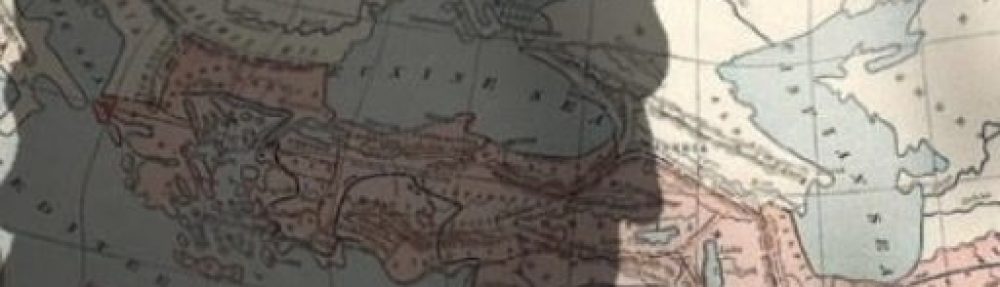
Welcome to Spearpoint’s Episode 7 art gallery! Ideally, you’ll read this blog post and view its images while you listen, or after you have listened, to Episode 7 (above). For that reason, the images are given in the order in which Malcolm and Frances discuss them. However, we wouldn’t want the blog post to make no sense at all just because you haven’t yet heard the podcast, so, brief explanations of each image have been provided. We hope you find them useful! If you have any comments, we’d love to hear from you either in the comments box or by email – spearpointatg@gmail.com.
Before beginning, we should add that if you would like to see our blog post for Episode 6, just click here, and if you would like to see more images of Alexander, Episodes 6 and 7 have their own Pinterest boards @spearpointatg!
One
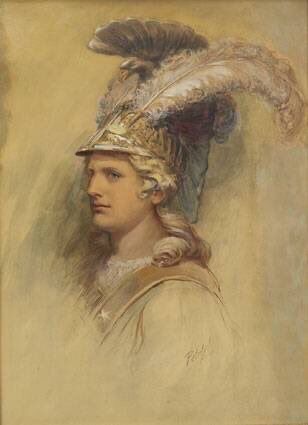
Episode 7 starts with this 1915 illustration of Alexander by August Petrtyl (1867-1937). Malcolm noted Alexander’s uncertain gaze: could it have been influenced by the First World War, which was then convulsing Europe? In a discussion of the Macedonian king’s hair, Malcolm reveals his rather unusual fashion taste!
Two
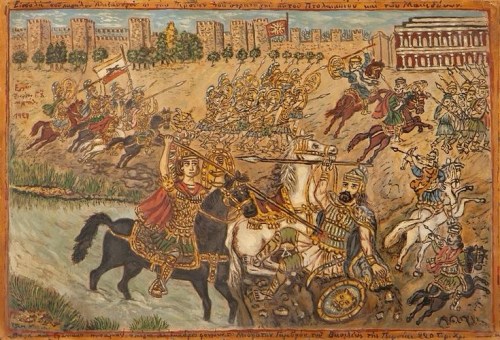
Theophilos Hatzimihail (1870-1934) was a folk artist whose work more than makes up in drama what it lacks in sophistication. Hatzimihail created this piece, which is a portrayal of the Battle of the Granicus River, in 1927. Full of action and drama it is a very raw but well thought out illustration.
Three
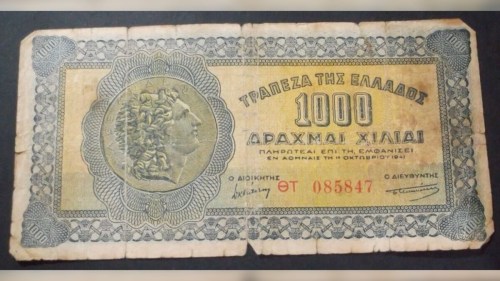
This Greek 1,000 drachma bank note went into circulation in 1941. Just as in the idealistic portrayals from antiquity, Alexander gazes into the distance, here with his head slightly tilted upwards. As Malcolm and Frances note, this image of Alexander is not the divine Alexander: he lacks his ram’s horns and larger-than-normal eyes – perhaps a nod, as Malcolm says, to Christianised Greece.
Four
This art work is by Photis Kontoglou (1895-1965). While the art style is Byzantine, Alexander’s head surely owes its origin to the Alexander Mosaic. The man on the right is a Greek statesman named Phocion. The art work can be found in Athens’ City Hall and is part of a much larger work that wraps around all four walls of the Municipal Council Chair’s office.
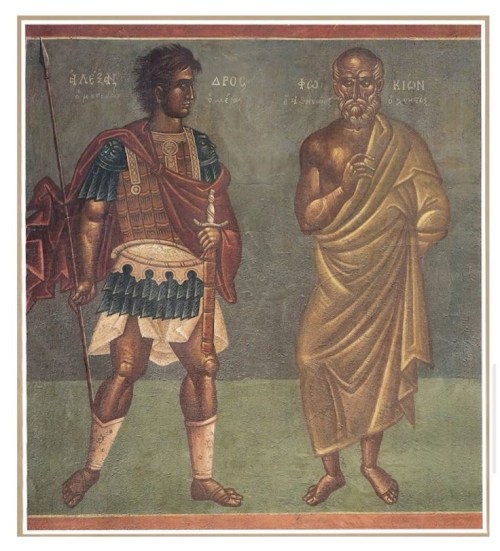
To read more about this work, visit the website of the National and Kapodistrian University of Athens here.
Five
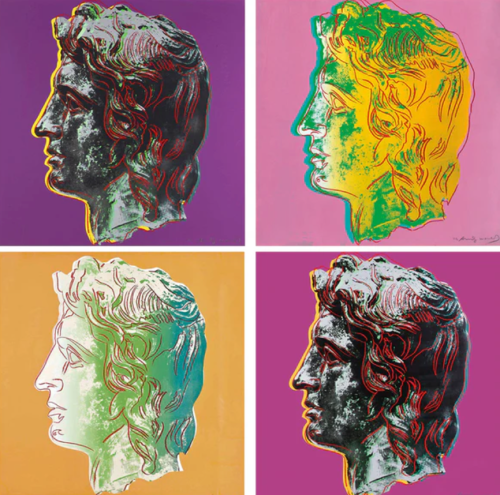
Having spent some time with images from Greece and by Greeks, we now move to the United States of America and the man who invented pop art: Andy Warhol. This image was commissioned by his friend Alexander Iolas and was created in 1982. Given Alexander’s fiery nature, the red background and streaks in his hair bring out his character perfectly.

Here is the image that Warhol used to create his print:
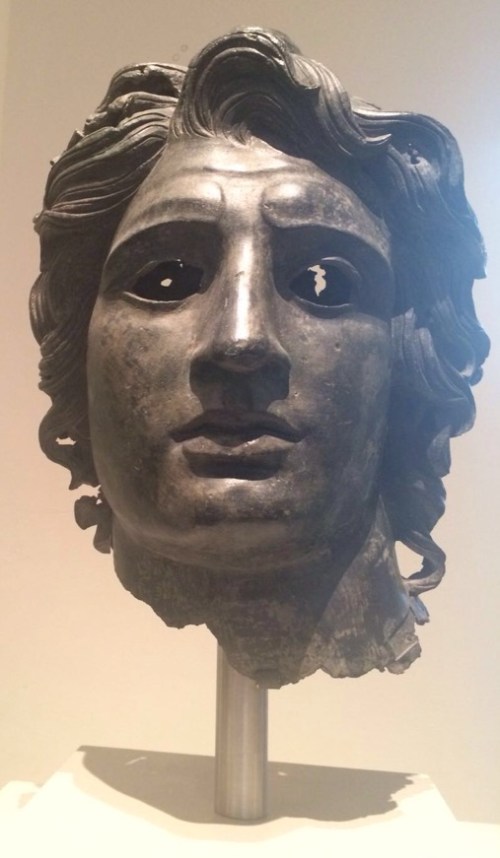
Note the crack in Alexander’s left eye. While it does look rather like a lightning bolt, it isn’t quite in the right place to make Alexander look like Harry Potter!
Here are some more versions of Warhol’s Alexander. These come (and can be bought) from the Tallenge Store here
Six
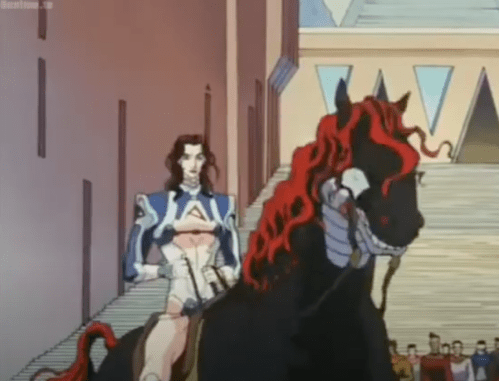
With the screenshot below we come to the world of moving images. Alexander Senki (1999) is a Japanese anime series loosely based on Alexander’s life. Loosely being the operative word here. The series combines history with science fiction. Darius III, for example, does not drive a chariot but a very futuristic tank.
In this screenshot, we see Alexander astride a red maned Bucephalus. You would be forgiven for not recognising Alexander but if you have read stories of the man eating Bucephalus, he perhaps will not look so strange to you.
Watch Alexander Senki on YouTube here
Seven
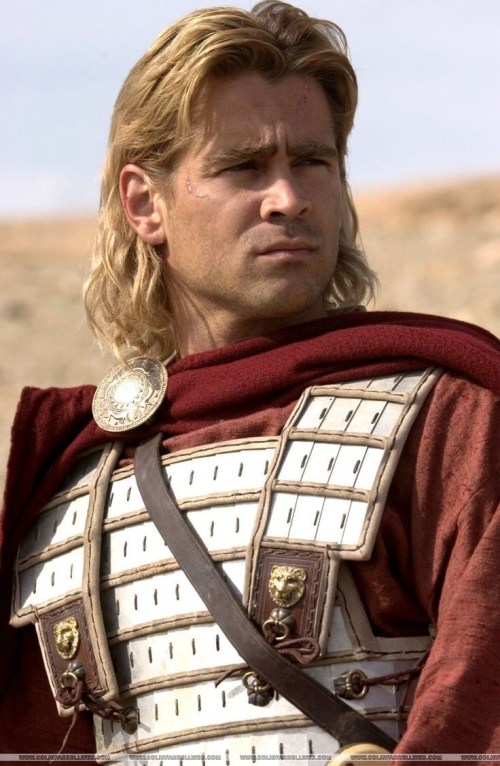
In 2004, famed director Oliver Stone released Alexander. It was an epic film with production values of the highest order but still not a success. An implicit acknowledgement of this has been Stone’s release of not one but several different versions of the film in the years since then: all attempts to find the best picture.
Did you know that Alexander scholar Robin Lane Fox is in the film? He plays a Macedonian cavalryman at the Battle of Gaugamela! See if you can find him:
The Battle of Gaugamela Part 1, Part 2, Part 3, Part 4
Read Lane Fox on his experience working for Stone here
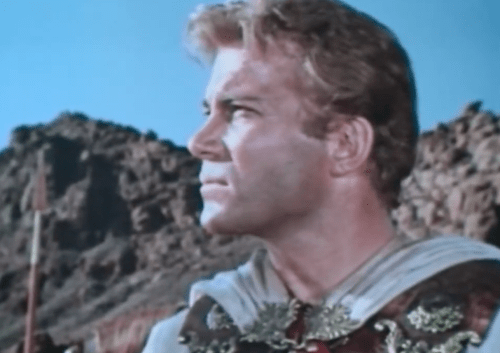
Here is William Shatner as Alexander from the 1963 pilot Alexander the Great. Unfortunately, the programme was never picked up as a regular series. Antiquity’s lose was science fiction’s gained as Shatner would go on to star as Captain James T. Kirk in Star Trek.
William Shatner wasn’t the only future hero who appeared in the pilot. Starring alongside him was none other than Adam West as a Macedonian named Cleander. Three years after Alexander the Great, he would become Bruce Wayne and Batman.
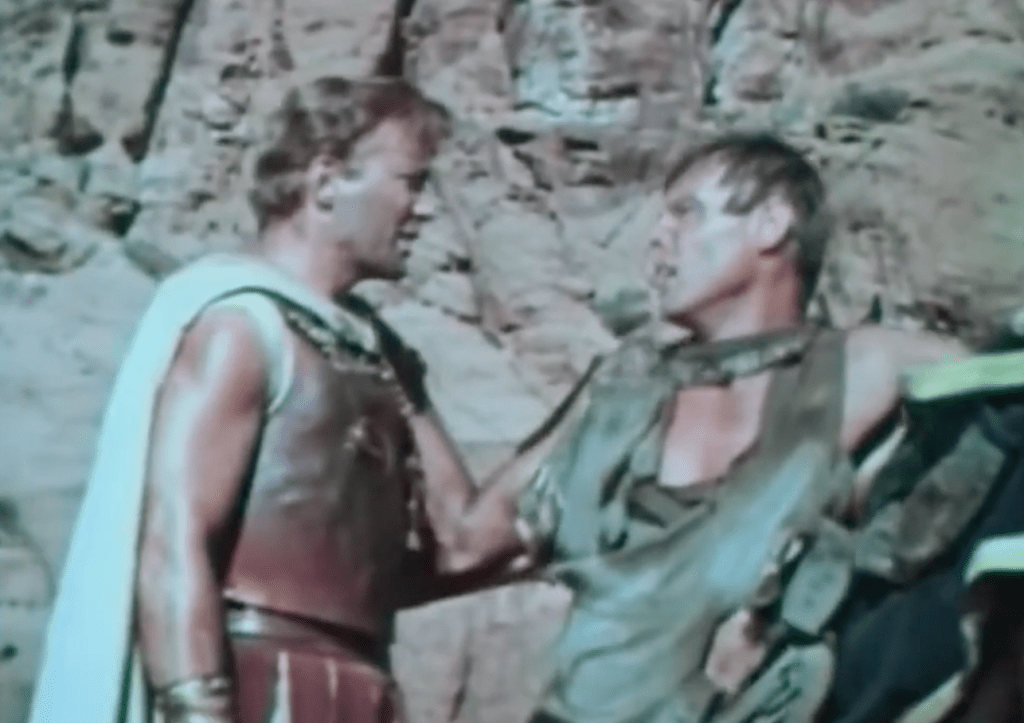
These screenshots are taken from Alexander the Great, which you can watch on YouTube here.
Eight
Twenty years after Oliver Stone’s Alexander hit the big screen, the conqueror returned to the small with the release of Netflix’s docu-drama Alexander: The Making of a God. The Macedonian king was played by Buck Braithwaite (below). Like Farrell, his hair is blonde (also like Farrell, Braithwaite is naturally dark haired). His Alexander, however, is a more restrained and menacing figure in comparison to Farrell’s melodramatic one.
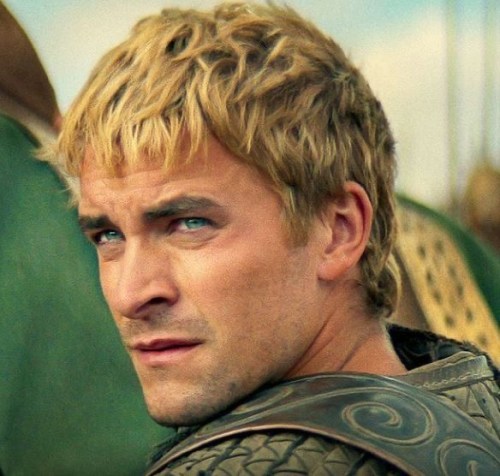
An oak tree. Why is this here? For the answer to that, we’ll let you listen to the podcast! A clue: the oak is, of course, Alexander (1:01:21 onwards!)

Nine
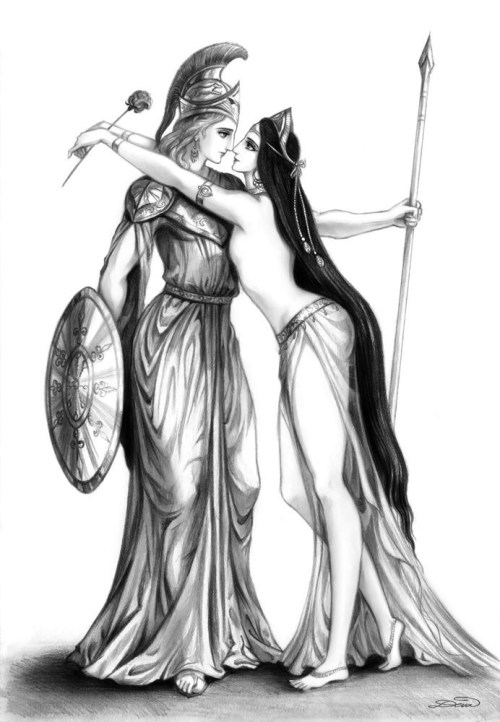
The late twentieth and first quarter of the twenty-first century have seen great progress in the fight for LGBTQ+ rights throughout the western world. That fight is still a long way from over but queer people are now far more accepted than ever they were before. The arts has played its part in this change. For example, both Alexander (2004) and Alexander: The Making of a God (2024) show Alexander and Hephaestion as lovers. That trend continues in this artwork by Develv, which shows a very feminised Alexander (L) and Bagoas (R) in a loving embrace. With their long hair, flowing robes and curved bodies, both Alexander and Bagoas could easily be taken for women. Have they been emasculated? Well, in respect of Alexander, surely it does something else entirely; namely, alert us to an aspect to his character, rarely, if ever*, explored before: his feminine side.
*It is certainly a world away, for example, from William Shatner’s Alexander
Ten
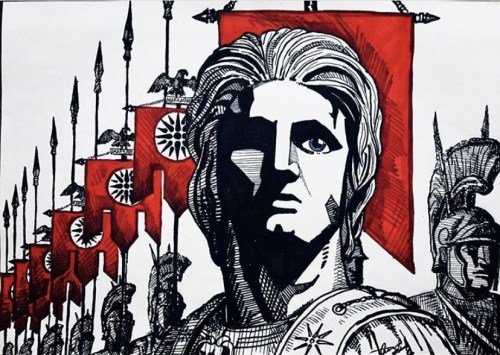
This illustration of Alexander by @stathopoulos_theodoros_ii (Instagram) is a deeply unsettling image in that it uses an artistic style redolent of Nazi art to portray the conqueror. What is the artist saying here, and about who?
+++
When we recorded Episode 7 our conversation went on for an hour and a half. To bring the episode down to a slightly more manageable length, we had, unfortunately, to cut out our discussion of several pieces of art. Here are a couple of them.
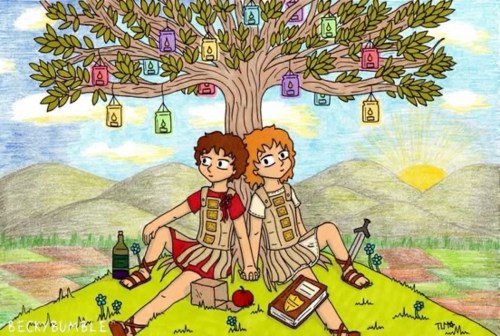
This illustration by BuckyBumble is a particular favourite of Malcolm’s as it combines Alexander with one of his most favourite books, Brideshead Revisited. Early on in their friendship, during the halcyon days of their youth at Oxford, Sebastian Flyte takes Charles Ryder for a drive. It is a beautiful day, and they stop by the roadside for a picnic. This is, Sebastian says, “Just the place to bury a crock of gold… I should like to bury something precious in every place where I’ve been happy and then, when I was old and ugly and miserable, I could come back and dig it up and remember.”
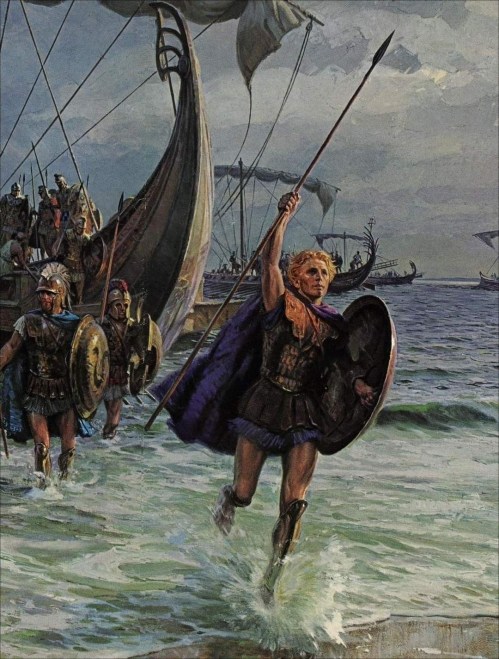
Finally, here is Tom Lovell’s portrayal of Alexander running ashore in Asia Minor. In a few seconds time, he will throw his spear into the sand and claim the Persian Empire as his spear-won territory. It is a very heroic moment, intriguingly undermined, however, by Alexander’s pinched appearance, which gives his face a skull like look.
Thank you for reading! We hope you enjoyed viewing the images and the listening to the podcast. Do you have any favourites of Alexander? We’d loved to hear which ones! Let us know in the comments below.
 Spearpoint